
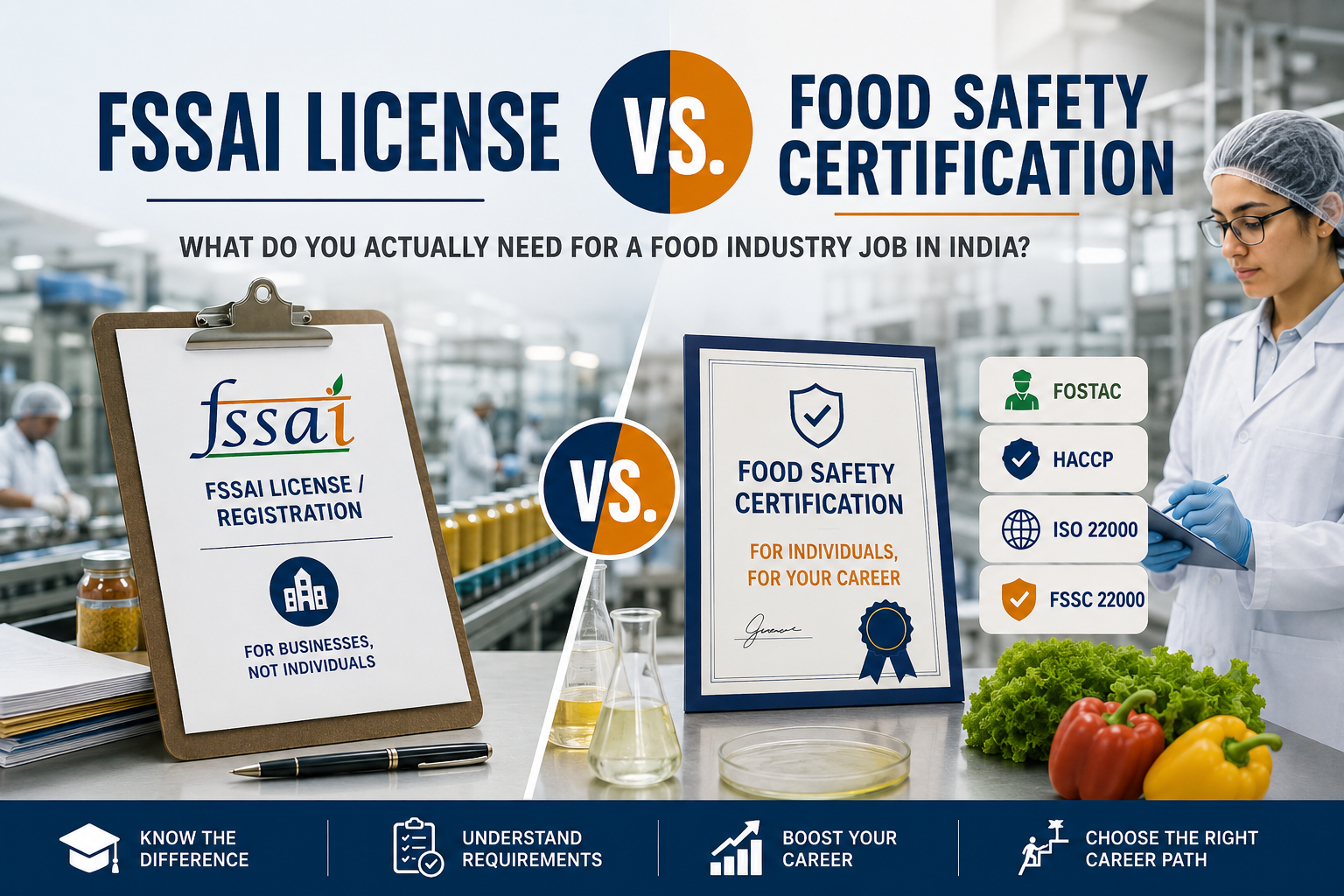
Let me start with something I have seen happen too many times. A fresh food technology graduate walks into a campus placement interview. The interviewer asks, 'Do you have any food safety certification?' The candidate says, 'Yes, I have my FSSAI registration.' The interviewer pauses. There is an awkward silence. And then the conversation moves on.
Here is the truth — FSSAI registration is not a certification. And not knowing the difference can cost you more than just one interview. If you are seriously planning a career in India's food industry, understanding the regulatory and certification landscape is not optional. It is foundational.
The Food Safety and Standards Authority of India, or FSSAI, is a statutory body under the Ministry of Health and Family Welfare. It was established under the Food Safety and Standards Act of 2006, and its job is to regulate the manufacture, storage, distribution, sale and import of food in India to ensure safe and wholesome food for human consumption.
FSSAI issues licenses and registrations to food businesses — not to individuals. If you are running a dabba service, manufacturing spices, operating a food processing plant, or even selling packaged snacks online, your business needs an FSSAI license or registration depending on your annual turnover.
So when a recruiter asks you if you have food safety certifications, answering with 'I have FSSAI registration' is like a doctor saying 'I have a hospital licence' when asked if they have a medical degree. Two very different things.
Food safety certifications are credentials awarded to individual professionals who have demonstrated knowledge and competency in food safety management systems, hygiene practices, quality standards, and regulatory compliance. These are the credentials that actually matter on your resume.
Here are the most recognised ones in the Indian food industry job market:
This one is directly from FSSAI and is mandatory for food safety supervisors in licensed food businesses under the Fostac initiative. If you are working or plan to work in a food manufacturing unit, hotel kitchen, restaurant chain, or packaged food company with an FSSAI license, at least one trained and certified food safety supervisor is required on premises. Getting FOSTAC certified signals that you understand Indian food safety law at a practical level, which is a genuine differentiator for entry-level and mid-level candidates.
Hazard Analysis and Critical Control Points is a globally recognised food safety management system. In India, most serious food manufacturers — especially those exporting products or supplying to large modern trade chains — operate on HACCP principles. If you are aiming for a QC or QA role, HACCP training is not optional. It is expected.
ISO 22000 is the international standard for food safety management systems. Companies seeking ISO 22000 certification need trained internal auditors on their team. If you hold an ISO 22000 Internal Auditor certificate, you become immediately useful to any food company trying to achieve or maintain this certification. Experienced professionals with Lead Auditor credentials are in high demand and command significantly better salaries.
The Food Safety System Certification 22000 is built on ISO 22000 and is mandatory for companies supplying to major retail chains globally. In India, suppliers to international buyers — think Walmart, Reliance Retail's global sourcing partners, or export markets — often require FSSC 22000 compliance. Certification training in this standard puts you ahead of most candidates.
The honest answer is: it depends on the role and the company. Here is a practical breakdown based on what food industry recruiters in India actually look for:
If you are a fresher (0–3 years), FOSTAC certification plus basic knowledge of HACCP principles is a strong starting point. It signals you understand Indian food law and can take responsibility on the shop floor.
If you are targeting a QC or QA executive role (3–7 years), HACCP certification and ISO 22000 Internal Auditor training are practically essential. Companies will not ask you to get them after joining. They want professionals who already have them.
If you are looking at managerial or leadership roles in quality, a Lead Auditor certification for ISO 22000 or FSSC 22000 combined with hands-on audit experience significantly strengthens your candidacy.
Even though FSSAI registration itself is a business credential, a thorough understanding of FSSAI regulations is absolutely essential for your career. Every food company operating in India is bound by FSSAI norms. Understanding licensing categories, labelling regulations, permitted additives, and compliance requirements is knowledge that employers value and test during interviews.
Many universities now include FSSAI regulations as part of their Food Technology curriculum, but the depth of coverage varies. Self-study using FSSAI's own resources, official circulars and compliance documents is highly recommended for anyone serious about a food industry career.
India's food industry is among the largest in the world and growing rapidly. But it is also getting more regulated, more quality-conscious, and more demanding about credentials. The days when you could walk into a food company and learn everything on the job are fading. Employers — especially organised sector companies, modern trade suppliers, and export-oriented manufacturers — now expect candidates who are job-ready from day one.
Get your FOSTAC certification. Study HACCP. Understand ISO 22000. And when someone asks you about food safety certifications, you will know exactly what to say.
